

“Dwell Time” denotes user engagement time on any website or webpage. In the ever-evolving world of search engine optimization (SEO), user behavior metrics are essential for drawing any conclusions. Dwell time is the most frequently discussed factor that affects your website’s performance in search engine results.
How is it measured? Whenever a user clicks on a link after SERPs and spends their time on the webpage, but before returning to the SERP. However, it is considered the interval between clicking on a link from the SERP and bouncing back to the SERP. Other metrics denoting user spending time, Engaged Session, Average Engagement Time Per Session, are in Google Analytics.
As Google and Bing consider it, both are refining their algorithms from time to time. They both have different importance for dwell time.
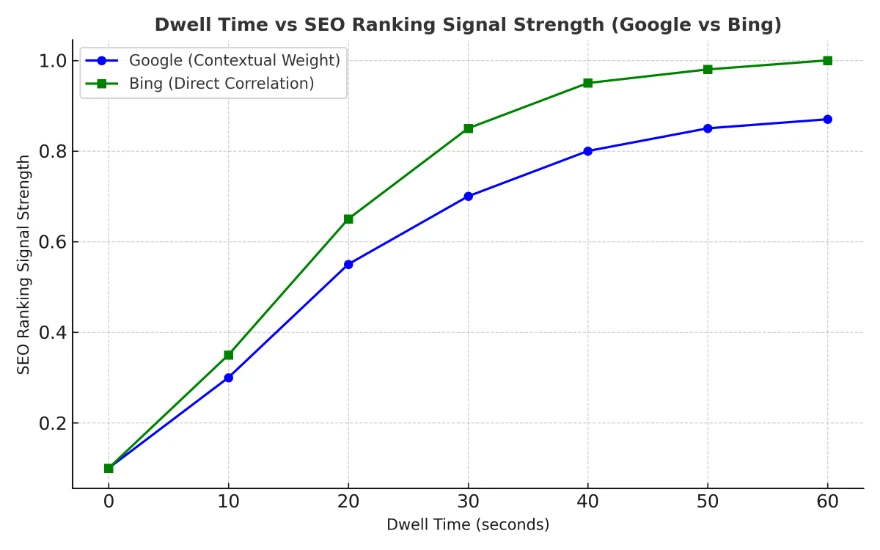
Compare to “Bing’s ranking signal increases more sharply with longer user engagement, while Google’s curve grows more moderately, reflecting its contextual approach to dwell time.”
The Hidden SEO Metric
For More, bounce rate or time on page, dwell time specifically tracks what happened between the moment a user clicks your site on SERPs, and when the user returns as well. Certainly, it is a signal of user engagement and content relevance.
Metrics Likely to Affect or Reflect Dwell Time.
- Average Time on Page
2. Bounce Rate
3. Exit Rate
4. Pages per Session
5. Session Duration
6. Click-Through Rate (CTR)
7. Scroll Depth
8. SERP Pogo-Sticking (Not a visible metric in GA, but it refers to users clicking your site, quickly going back to the SERP, and clicking other results.)
How It Impacts User Experience and SEO
However, a longer dwell time generally suggests that the content is very useful, engaging, and satisfies the user’s intent as well. When a user quickly returns to the SERPs within 5 seconds, it often signals that the content didn’t meet their expectations.
Dwell time correlates with key user experience (UX) metrics.
- Content depth
2. Readability
3. Site speed
4. Mobile-friendliness
5. Visual appeal and layout
By improving dwell time indirectly boost your SEO by reducing pogo-sticking and increasing perceived value as well.
Dwell Time in Google’s Algorithm: Does It Really Matter?
In 2025, Google still has not confirmed using dwell time as a direct ranking signal. But it certainly emphasizes user satisfaction and experience. Google tracks other metrics like click data that rely more heavily on AI-driven behavior analysis.
- Click-through rate (CTR)
2. Engagement signals (via Chrome and Android telemetry)
3. Core Web Vitals
4. Helpful Content System updates
Recently, Google’s March 2024 broad core update shifted focusing more on “satisfying content”. It does metrics like dwell time indirectly through behavioral modeling.
What About Bing? Dwell Time’s Role in Microsoft’s Search Engine
Apparently, Bing has publicly acknowledged using dwell time as part of its ranking algorithm system. It considers a longer dwell time as a positive signal that a page has high-quality content.
How Bing evaluates.
How long a user stays before returning to SERP
The time the user spent on a page before going back to the Bing SERPs. A longer time signals that users found the content useful and engaging.
Whether they visit another result afterward
This indicates your content didn’t fully satisfy the search intent. And the user clicked another more appropriate result after yours.
If they return to Bing at all after the session
It is quite interesting, if users don’t return after your page view, it surely signals they found what they need.
Suppose a user searches “what is dwell time” on Bing, clicks on any webpage, reads thoroughly, and closes the browser. And opens YouTube or checks emails further. It surely means that the user didn’t return to Bing for another search.
“This webpage answered the user’s queries perfectly. They didn’t need to search anymore.”
Recently, in 2025, Bing’s algorithm update was named “User Intent Harmony”. It places greater weight on dwell time, user satisfaction, and multi-click sessions as well.
Google vs Bing: A Comparison of Dwell Time Value
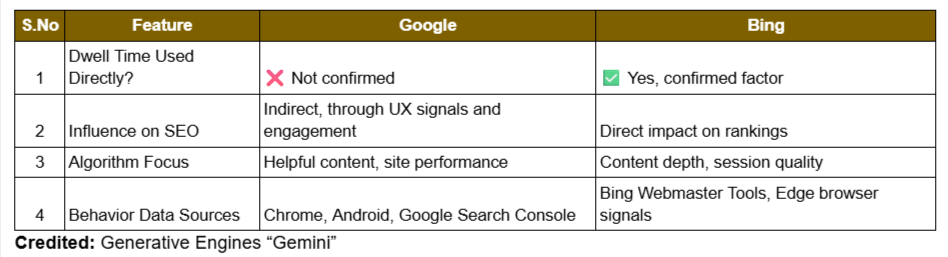
It is well considered that, if you’re optimizing your website for Bing searches, dwell time should be a priority. On the other hand, “Google” sees broader content and Ux strategy more than this.
Tips to Increase Dwell Time on Your Website
Here is a thorough, detailed guide for optimizing websites to better dwell time.
1. Improve Intro: connect with the readers within the first few seconds.
2. Use headings & bullets: Readability, and content structure.
3. Add internal links: thorough explanations, deep analysis of the topic.
4. Embed multimedia: Use videos, infographics, and images, etc.
5. Speed up site: Optimize for better loading times, as it directly affects user behavior.
6. Write for humans: content should be conversational & valuable for users.
Dwell Time as a Strategic SEO Signal in 2025
Apparently, “Google” and “Bing” see dwell time differently. But keeping users engaged on your website is more important than ever in 2025. Bing is considered a ranking factor, so optimize accordingly. On the other hand, Google sees user satisfaction, influencing your content performance indirectly.
FAQs about Dwell Time:
What is dwell time in SEO, and why is it important?
Dwell time generally refers to how long the user stays on any web page. After clicking it from SERPs to return to SERPs. It helps search engines to understand content relevance and user satisfaction more.
Is dwell time a direct ranking factor for Google?
No, Google hasn’t yet confirmed it as a direct ranking factor. But a higher dwell time can surely indicate valuable content.
How is dwell time different from bounce rate and session duration?
Basically, bounce rate tracks single-page sessions, and session duration tracks time spent on a website. And Dwell time measures the time between clicking a SERP result and returning to the SERPs.
How does Google Analytics measure dwell time?
Not directly, but Google Analytics tracks metrics like session duration and bounce rate. You can choose custom setups or third-party tools to estimate dwell time.