
Why Text-Only SEO is Failing B2B
Now, you cannot rely on long form blogs to capture a high volume of keywords. Scenario has changed, google search and other LLMs search are prioritizing multi modal content optimizations.
Why?
The reason behind it, AI engines are programmed to reduce “hallucinations”. They are designed to look for authoritative, verified data points to support their summaries. If any video that is explaining a complex system or process, supported by structured data (schema), would be providing a higher “trust signal” than any generic AI written article. Every B2B business must provide content in the format to be cited in an AI answer.
Video SEO for LLMs better Understanding and Indexing Videos
LLMs systems do not “watch” your video exactly as humans do, they generally “read” the metadata and transcripts to understand the concepts. Here, you need to follow an Anchor Content strategy to rank a b2b video on search prompt.
Now, video seo is no longer a purpose to rank on YouTube or appearing on SERPs only. An effective video seo optimization could help search engine and AI searches. It collects information through structured metadata, transcripts, timestamps, and schema markups.
Since LLMs or better known AI search primarily interpret the text surrounding a video rather than the visual content. The video optimization should be focusing on rich contextual signals.
This is no more secret, combining quality video with the supporting content, businesses can increase online visibility. Also AI systems like Google AI Search, AI Overviews, Chat-GPT, Gemini, Copilot, and other AI search experiences needed for search authority.
It’s better to combine structured texts with video assets strongly correlated with the AI overview inclusion. And a timestamped transcript gives search engines and LLMs the structured textual data that is essential for indexing, mapping and citing the video content.
By SparkToro: Best way to structure multimedia assets early on the page. A data that says LLMs citation analysis tells us 44.2% of all generative AI citations are pulled within the 30% of page content.
A Survay from Hubspot reveals secret
| “Search Engine Scope – Technical SEO agency specializing in B2B architecture”
Create AI-Friendly Videos that Direct Answers with Search Intent
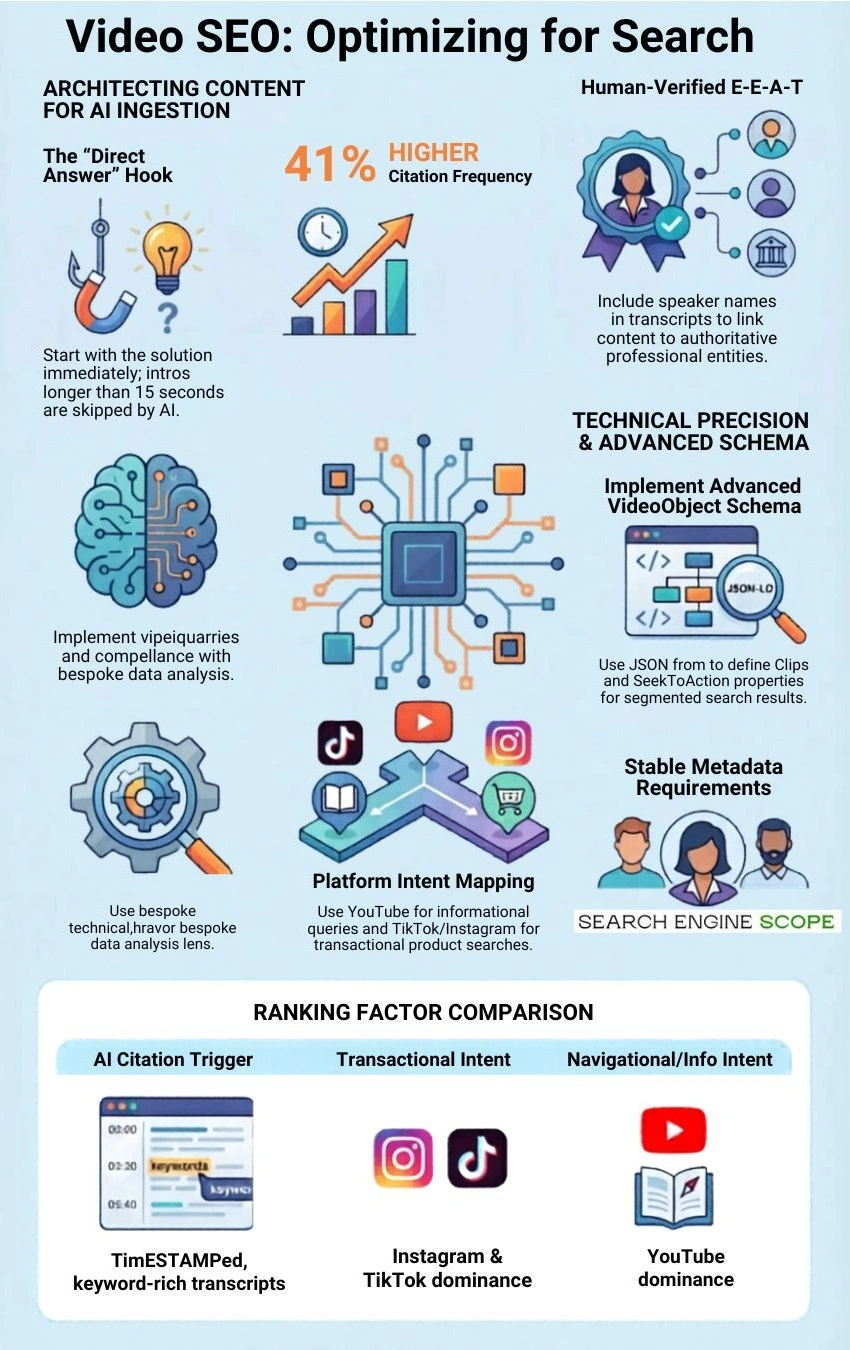
The first 30 seconds of video must answer the specific b2b pain point directly to engage. LLMs focus on “snippet-friendly” sections. If any video that starts with a 15 second intro will be skipped by the Ai system.
Must start immediately with, “To solve [Problem] in [industry] etc.
Video Transcript Optimization for Better AI Visibility
Transcripts are the “secret weapon” and bridge between video and LMMs.
1. Must include the speaker’s name, it helps to establish E.E.A.T(Expertises, Experience, Authoritativeness, and Trustworthiness).
Who is speaking is as important as what is being said. A speaker’s name within a transcript provides a clear signal to search engines and LMMs regarding human entities. This supports E.E.A.T signals, including these names to professional bios or linkedin profiles helps Google’s knowledge graph.
2. Keyword alignment matters, don’t just talk but use particular search terms.
Users from specific regions often use sophisticated industry terminology when searching for solutions. Video script and subsequent transcript should include primary keywords as well as LSI (latent semantic indexing) terms.
3. Video should be professionally formatted and timestamped.
Constructing a clean, timestamped formatting directly beneath the video will serve two purposes, i. It allows users to skim for the specific information they need. Ii. It provides a chronological map of your content to the search bots.
Timestamps provide a “table of content” that google likely uses to generate “key movements” in search results. It is significant to increase real estate on the SERPs and for better click-through rates.
Implementing Advanced VideoObject Schema Markup for Higher Rankings
Structured Data (Schema Markup) is a “translator” that tells a LLMs system about content. At an advanced level, generic “Article” schema is no longer enough but “VideoObject” and “Clip markup” should be implemented.
Essential VideoObject Schema Properties (JSON-LD)
To win in 2026, your VideoObject-schema must include:
1. hasPart (Clips): This is for “Key Moments” in your video. It provides google to show a segmented timeline in a search results.
2. Transcript: Paste full transcript inside the schema code. This will ensure AI doesn’t have to “guess” the content.
3. Author: Provide a Person schema of the subject matter expert to reinforce authority.
VideoObject Schema Example (JSON-LD)
{ “@context”: “https://schema.org”,
“@type”: “VideoObject”,
“name”: “How to Scale SaaS Operations in the US & EU”,
“description”: “A deep dive into B2B infrastructure scaling and GDPR/CCPA compliance for 2026.”,
“thumbnailUrl”: “https://searchenginescope.com/thumbs/saas-scaling.jpg”,
“uploadDate”: “2026-02-21T08:00:00+00:00”,
“duration”: “PT5M20S”,
“contentUrl”: “https://searchenginescope.com/videos/saas-scaling.mp4”,
“embedUrl”: “https://searchenginescope.com/embed/saas-scaling”,
“author”: {“@type”: “Person”,
“name”: “Expert Name”,
“jobTitle”: “Head of Growth”,
“sameAs”: [ “https://www.linkedin.com/in/expert-profile/”,
“https://twitter.com/expert-handle” ] },
“publisher”: { “@type”: “Organization”, “name”: “Search Engine Scope”,
“logo”: “https://searchenginescope.com/logo.png”, “sameAs”:
“https://www.linkedin.com/company/searchenginescope/”
“https://www.crunchbase.com/organization/searchenginescope” ] }, “hasPart”: [
{ “@type”: “Clip”,
“name”: “Navigating GDPR vs CCPA Compliance”,
“startOffset”: 45,
“endOffset”: 120,
“url”: “https://searchenginescope.com/video-page#t=45” },
{ “@type”: “Clip”,
“name”: “AI-Driven Market Analysis”,
“startOffset”: 121,
“endOffset”: 300,
“url”: “https://searchenginescope.com/video-page#t=121” } ], “transcript”: “INSERT_FULL_TEXT_TRANSCRIPT_HERE_FOR_LLM_INDEXING” }
Optimizing Clip Schema & SeekToAction Schema Markup
Must use “Clip schema” It lets you manually define the segments, and “SeekToAction” tells google directly how to automatically jump from one part to another in a video.
It helps, when a long form of b2b webinars holds Or product deep dive videos.
How this “SeekToAction” works, when you enable this Ai search engine to pull specific “how-to” answers from your video and present it as a direct solution in the search result.
Building Authority Organization Schema and Entity SEO
Present scenario you aren’t working for ranking but creating an entity(Brand) to be cited by LLMs
First, Organization Schema: it’s important to ensure your video pages are wrapped in a “Organization Schema” and linked with your official social profiles and office locations as well.
Second: Must use the “SameAs” property to link your brand to authoritative sources like Wikipedia page, linkedin company page, or Crunchbase profile as well. This will work as verified sources for LLMs can understand the “expert video” with a “trusted business entity”.
Video Distribution to Increase AI Citations and Search Visibility
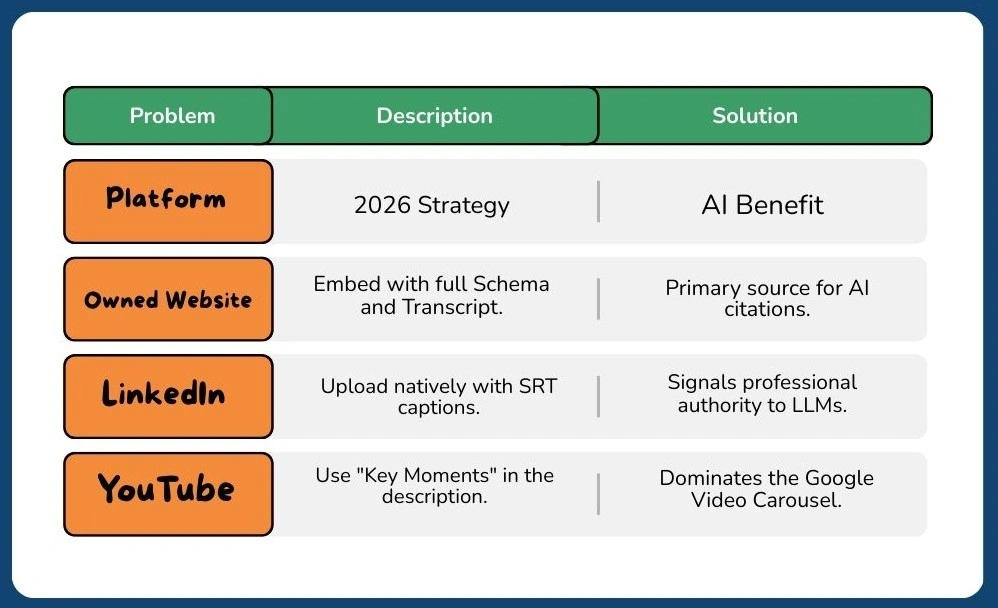
The way you distribute your video affects how LLMs perceive its authority.
How Video SEO Will Helps You Appear in AI Overviews
This shows how any brand or specific citation appears on the result after prompt, on the AI overview summary.
How it seems: when a user searches for, “best website optimization service in US” Or “technical seo service in ohio”. Here, Ai generates a paragraph with “search engine scope” as the best solution.
Why matters: user approach has changed, they read AI summary instead of scrolling down to the “blue links”. At this point, if your brand is mentioned inside that box, you get “share of model”.
It will improve, when you directly “definiton-style” language in the video transcripts.
How Video Rich Snippets and Key Moments Improve CTR
This shows how any video appears in the traditional search results. Instead of a thumbnail, with a “rich snippet” included timeline of any “key moment” so the user can click to jump on a particular part of the video.
“Zero-Click” scenario: If a video has a rich snippet, it could have 3x more space on the mobile screen than a text result.
How to Validate Video Schema in Google Search Console
1. Go to Google Search Console. 2. Click on enhancements > Videos. 3. “Critical issues”. Here if your schema markup is correct, you will definitely see green “valid” signs in “key movement” and “SeekToAction”.
If you think, optimizing for video and schema is a technical task or requirement only, “no”. This is a must for b2b growth.
Video SEO & Video Schema Markup FAQs
1. How does Video Schema influence AI Overviews?
Ans: AI search engines don’t just “index” video, but they “ingest” it. Best to use VideoObject and transcript properties, it provides a machine-readable version of your content. And this allows LLms to cite your video as a primary source for complex queries as well.
2. What is the difference between Clip Schema and SeekToAction?
Ans: Basically, clip schema markup is manual. Here you define the specific start and end times for segments (e.g. “intro”, “Step 1”, “Conclusion”). On the other hand, SeekToAction is a more advanced version, it tells google’s AI overview how url structure handles timestamps, and allows the search engine to automatically identify and “jump” to relevant sections of your “video” based on prompts.